Tuesday, April 19, 2011

The orphanage -- count 59


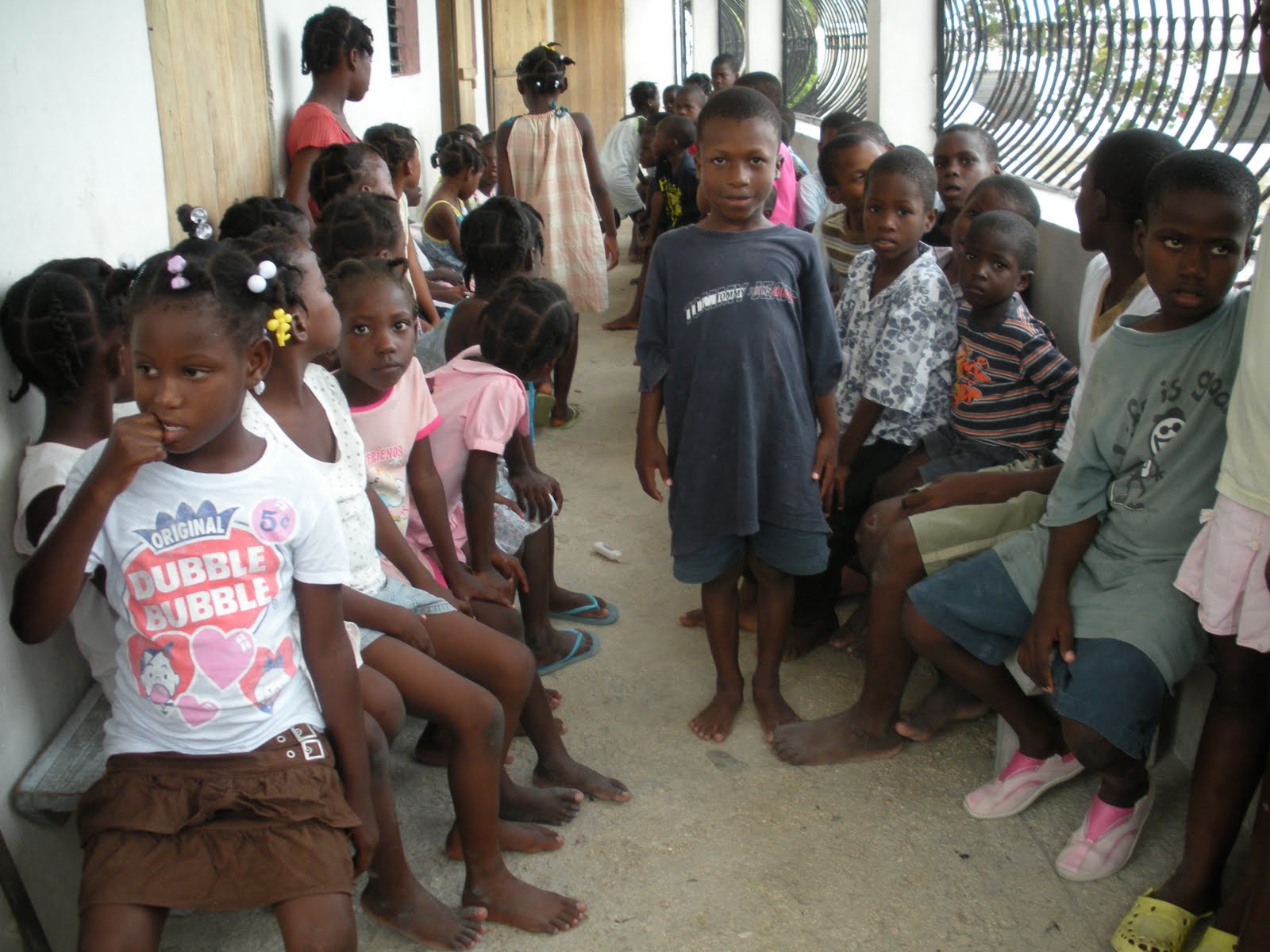
One of the most emotionally mixed days in Haiti last year was the day we visited the orphanage on La Gonave. We met 59 little ones; the girls sat on one long bench together, while the boys wiggled and squirmed on the other. The girls sat together, gently braiding hair, talking and giggling. The boys shoved each other, pushed each other and called out for more and more pictures to be taken. One little girl stood out from the others --Betsiina. She was to be adopted soon by a Canadian/Haitian couple. The other kids knew it. She was teased and told that her new family would hit her. She didn't want to go.

Many of the children, I'm told, have biological parents who live in the town adjacent from the orphanage. In some cases, the parents just can't provide for the children and so they are sent to the orphanage. In Betsiina's case, she was being sexually abused by her older brother while her mother was out looking for work during the day. And so she was sent to the orphanage where, her mother hoped, she could be better protected. It seemed that many of these children have no supervision during the day, no one to look after them except for older siblings. I kept wondering, does Haiti need orphanages for its children, or just free quality day care?

Monday, April 4, 2011

Earthquakes, Tsunamis, Coconuts


While in Haiti last June, we got a chance to travel to Petit Goave to visit the missionary compound. It’s a green space, over looking the ocean. Sail boats bob up and down, the water is clear and clean. All is calm. Coconut trees provide some shade. As I’m walking, a group of kids join us. One girl has a pretty torn party dress on and she loves to have her picture taken. Some have been swimming in the ocean. They tell me that they like to swim and ask me to join them. I laugh and tell them that I don’t have my swim suit. They ask me if I know how to swim. I laugh and ask them if they know how. They tell me that they know how to swim and that they like to swim.

I ask them what happened when the earth shook. They shook their arms in the air and they told me that it was so strong. I asked if it was really strong. They all shook their heads together and said “Yes, really strong, really strong”. I asked them about the noise? What did it sound like? They said “it was loud, really loud” They said “it was like zzzzzzz.” I said where were you? He pointed next to the house where he was. He said his mother hurt her foot, but that he didn’t get hurt, he is okay. He shows me his arms and his legs. Just then a coconut drops from the tree and slams to the ground from about 30 feet up. I had forgotten about those coconuts.

I asked them “what did you do after the earthquake.” He showed me the ground where he had to sleep. He said he had to sleep outside in the open. It’s too dangerous to sleep under the coconut trees where the coconuts can fall on you. He said the problem was that the sun would boil them in the morning, and it was too hot.

He told me his story several times. I asked the others too about it, trying to get them to talk about that scary time, trying to get them to help me understand. The second boy tells me that they had to run away from the ocean so that it wouldn’t come get them. I realize that he is talking about the Tsunami warning. They had three problems – coconuts, earthquakes and tsunamis.

I take their picture and I show it to them. They laugh. I ask them if they go to school and they tell me yes. They start to tell me what things are in English and then they translate the words into Kreyol for me – they are teaching me. They walk me to the car and I ask them if they are going swimming again. They say they will get fish to eat.
We drive away in our car to head back to Port-au-Prince. I think to myself - I only had to worry about falling coconuts today.

Friday, April 1, 2011

Haitians helping Haiti -- Mangos + Social Programs


Last June, directly after the earthquake in Haiti, I met with Jean Maurice Buteau. Some call him the Mango man. He buys and sells Mangos directly from farmers all throughout the Haitian country side and is one of the largest Haitian exporters. His mango producers are from small orchards, are grown without pesticides and are simply amazing.

But, as much as I love mangos, this is not why I'm writing this blogpost...

We hear much about the good that others in the world are doing for Haiti. We hear about big donor organizations, we hear about non-profits, not-for-profits, aid organizations, governments, celebrities, etc. I have and do applaud this work, but there are more applause to go around.

What I'm most interested in these days is post-disaster reconstruction by those on the ground and those from the ground. In other words, who are the in-country, in-state, in-town heros who can teach us about what works on the ground in a post-disaster situation?

Here's a quick look at what Jean Maurice is doing:
1. Exploring ways to increase crop production and farmer profits in Haiti
2. Supporting a high school in Fond Jean Noel since the mid-1990s, including installing solar panels, computers and internet access. In addition, training programs by a Haitian IT company were provided.
3. Supporting local neighborhood sports teams in order to give kids access to after school activities.

http://www.mango-haiti.com/social.htm

These programs help Jean Maurice's company thrive because he needs to hire skilled workers, he needs to work with farmers who can produce high quality mangos and because we need more Haitian soccer players in the world.

Thursday, June 3, 2010

Speaking Engagement

On Tuesday evening, I headed off to speak with local business and education leaders in Haiti. My father's friend, Edouard Lafontant set up the speaking engagement.

I was picked up at 2pm at my hotel in Petionville and we drove toward the road leading to Montaigne Noir, the road I used to take home everyday. It was as I remembered, narrow streets and high walls surrounding the homes. We drove up a steep driveway to a home situated on a hill. The bright orange colors of the patio jumped at me. I was a bit nervous. What would I tell them that they already didn't know?

The topic was rebuilding Haiti with Haitian eyes. By that I mean, trying to understand and point toward a vision, a Haitian vision, of Haiti that builds on her assets vs. focusing on the overwhelming needs. In other words, what does Haiti have to offer to the world. What might be her competitive edge, what are her strengths, and what already works in Haiti that we might be able to harness and build upon? Once we have a clear sense, a clear vision of Haiti and what we want her to be, I suggested we might be better able to lead the charge in that direction. We might be able to better determine what will work in Haiti and what won't.

After the talk, Edouard Lafontant spoke about the importance of leadership, what it means and how to build it. How it's important to build capacity in the leaders by instilling in him the idea that great leaders lead others to greatness in such a way that they don't know that they have been led.

The discussion after the talk was insightful, lively and engaging. We discussed how to do everything at the same time, we discussed some frustrations and we thought about what works in Haiti and what doesn't. We also talked about how MIT might contribute.

At the end of the talk, I felt charged and refreshed. I felt the doors begin to open, especially the doors to a group of strong women who attended the discussion. Lots to do.

Wednesday, June 2, 2010

Reunion with Anne Marie -- raw writing

Anne Marie

She was standing at the corner, she looked at me. We locked eyes. It was she. The emotions came, the crying almost wailing and I couldn’t stop them. She was alive, she had her arms, she had her legs, her smile, and we embraced, I kissed her and the love flowed, I couldn’t stop it. So many days wondering and wondering, if she were alive and there she was, there she was. She says she lives in a house and she is safe. Then she tells me her daughter, Jeanette, lives in the tent across the street. There's more, but I can't translate it into words right now. Maybe later...

Off to Jeanette's tent. Anne Marie takes my arm, Joy, my best friend, follows and we walk. We cross the street, not an easy feet. We cross the small street and we are headed to Jeanette’s place – a tent across the street. I’m nervous, what will I see, what will I hear, will it be dangerous, will it be clean, will I get a disease?

The walk way is mud and there are women sitting. I say hello to all. Three boys follow me and they say “I love you.” I turned to them and I looked them in the eyes. I said “I love you too,” and I meant it. They stopped following us.

The tent was clean and neat. A rug on the ground – a luxury. Two single beds with clean sheets. I’m invited to sit down. I’m invited to talk. I’m invited to their private world. We talk about my family. All of the children, uncles, aunts and children of children. I ask about the private relms of my family. Why don’t some people not like others? Why, why, why? She answers me as best she can. I just expect her to know what I want to know, and to know how to explain it all as fast as possible. It is impossible. We talk and talk. A women washes near by. I cry and they hand me a towel and it is white and pristine. It is cleaner than what I might find in the finest hotel. The white towel, the mud outside, the clean tent, sheets and rug. Why didn’t I take off my shoes before walking on their rug…

Later that night I wake up in my bed at 1am. I can't sleep. Jeanette lives in a tent no more than 50 feet from my hotel room. We used to sleep in the same house, now I'm the only one in a house.

Sunday, May 23, 2010


As you know, half of my family is from Haiti and I've been involved with a number of Haiti-related projects. Here's the scoop....

First, with a bunch of friends, we began raising money for an initiative that I started for Haiti with my best friend from Union School, a school that was located in Port-au Prince, Haiti. Our initiative is called Hearts and Hands to Haiti, sort of a bucket brigade, and there is a link online: http://www.causes.com/causes/433147?recruiter_id=13530475

To date, with the help of many of you, we have raised about $26,000 and have been able to land 2 tons of food and medical supplies. In addition, we sent a team of construction and medical workers to Haiti (they raised their own funds for the trip) to build a temporary health clinic and train medical staff. The clinic is located in Leogane, Haiti. We also were able to staff the clinic and arranged for a doctor to visit once each week. The work is not done, but at least we have started in a small way.

So what now?

The cameras are mostly gone and the devastation remains. On June 1st I'm headed to Haiti and I need some help...

As part of this trip, I plan to visit the clinic that our organization built and staffed and bring in more supplies. I also plan to visit an orphanage run by a non-profit that we are working with, a school that is the sister school to an elementary school here in Cambridge, and, as noted above, meet some of Haiti's business leaders.

Many of you have asked me to update on you this work and asked if there is anything that I need. The answer right now is Yes! Here's what I need:

1. Apparel/Toys for Kids: I would love to bring apparel/toys for kids - Shirts, hats, paper, pens, pencils, small toys. These kids need to play and have fun and I would love to give them a few things to distract them, if only for a moment. Again, mail donations to me at: Cherie Miot Abbanat, Department of Urban Studies and Planning, 9-367, 77 Massachusetts Avenue, Cambridge MA 02139.

2. Medical Supplies: I would like to fill a couple of duffle bags with supplies to bring to the clinic. If you would like to contribute to these efforts, you can donate things like flashlights, pain relievers, tarps, anything that you might find at a drug store, and I will bring it all in with me. You can mail or drop off donations to me at: Cherie Miot Abbanat, Department of Urban Studies and Planning, 9-367, 77 Massachusetts Avenue, Cambridge MA 02139. (I can write receipts for all donations from the non-profit 501(c)3 that we are working with on these efforts.

3. Ask Kids to Write Care Notes -- If you have kids ask them if they might be interested in writing notes and/or drawing pictures for Haitian kids -- Kids love kids and my kids want to do something for the kids in Haiti. (I've posted a few beautiful pictures that I will take with me.) I've asked my kids and their friends to write notes to kids in Haiti asking questions, expressing ideas, and relaying thoughts that they care -- a little letter writing campaign that I thought I would try out. As noted above, I plan to visit children in schools and in orphanages and in tent camps and would love to bring notes from kids here to kids there (we will translate these for the kids). Mail them to me (see address below) or scan and comment here and I will tell you where you can e-mail them.

4. Donations: If you prefer to write a check, sometimes this is easiest when people are busy, checks can be made out to "Shunem" (and write "Haiti" in the note section). Shunem is a 501(c)3 that has agreed to cover all of our overhead costs. You can also donate on-line at: http://www.causes.com/causes/433147?recruiter_id=13530475.

Thanks in advance for your help and support with these projects.

Also, if you want to remain in the loop in terms of this project, I will be blogging about the trip at: http://heartsandhands4haiti.blogspot.com/2010_03_01_archive.html

Kenbe La!
Cherie

Sunday, March 7, 2010

Hearts and Hands to Haiti (Shunem.org) -- On the Ground


One of our team members, John Vermilya, and his crew of 6 carpenters arrived last week in Haiti and have been working to build, build, build as much as then can. These are a group of men who have helped H&H2H raise money, find supplies and then went off to bring their Hearst and Hands to Haiti. Partnering with World Hope International, they got a clinic built in one week. Now the nurses can attend to patients in a clean environment instead of on a dirt floor. Also, John was able to find and connect with a doctor who will visit the new clinic once each week! I'm amazed at their effort, generosity and kindness.

Wednesday, March 3, 2010

Technology Divide? Technology Leap?

This week I had the opportunity to speak with Lady Sarah Ferguson, Duchess of York. It was a small discussion, only about 5 of us and we spoke about our hopes for Haiti in terms of Education, Energy and Environment. It's hard, though. It's hard to figure out how to deploy technology that could help Haiti take a giant leap forward in terms of education, energy or communication. How can we connect Haiti to the world with new technologies when people have nothing to eat. Here is just the short list of things to do...

We need to:
Continue relief efforts: Provide tents, food, water, medical care

Focus on rebuilding and renewing Haiti:
Educate in innovative ways,
Add electricity generating capacity,
Strengthen the government,
Eradicate poverty,
Raise the minimum wage,
Root our disease,
Focus on economic development,
Rebuild the infrastructure,
Reforest the country,

among so many other tasks.

So where do we begin? Where do we place the first stake in the ground? How do we know that if we have started in the right place and what do we displace when we add a new gizmo, a new method, a new seed?

These are just a few of the questions racing around my head each day as I attend these meetings, learn about new technologies and innovative development ideas. But, as I consider each option, I continue to land in the same place: What does Haiti want its future to be and who gets to decide?

Tuesday, March 2, 2010

Supplies and Team make it into Petit Goave for the Week


Hearts and Hands to Haiti sent more than supplies this time to Haiti. Sunday we sent a team in to deliver medical supplies, food supplies, clothing, and a box of eye glasses. In addition, the team will also work in Haiti for the week. Their task: Do whatever is needed. First the team will focus on building a wall for one of the clinics and then move on to other tasks, if they are able to complete this one. John Vermilya and his team will also work to check in with some of our team mates on the ground already in Haiti who have been coordinating supplies, doctors, rescue teams etc. It will be a lot of work for them, but we are happy that they are able to help.

Tuesday, February 23, 2010

Hearts for Haiti Project -- Ruskin Elementary School, Waycross GA


Hearts and Hands to Haiti (H&H2H)just received a check for $281.50 from Ruskin Elementary in Waycross Georgia! The students purchased hearts, decorated their hearts and then posted their hearts on the bulletin board at the main entrance to the school. We will be using their donation money to purchase food, medical supplies and fuel for clinics and we will deliver this next wave of aid on Sunday! Amazing what a few decorated paper hearts can do for others!!

Saturday, February 13, 2010

Haiti's Fondwa University and MIT -- A connection?

Students from the Department of Urban Studies and Planning (DUSP) came together to a forum arranged by DUSP's Students of Color Committee (SCC) to watch "The Road to Fondwa." As part of this form there were a few of us Haitians and Haitian Americans as well as the director of the film. I was amazed at the turn out and the energy in the room.

To me the film seemed to capture the sights and sounds of the Haiti I remember. It was heartening. By way of background, Fondwa university is the only university in the country that teaches its students in the native Creole of the country. All other universities, the one that my father and uncle attended, teach in French. What Fondwa is trying to do is to educate people in their own language to learn about and take care of the land. Fondwa's focus is on sustainable farming and animal husbandry practices. Here is a link to the movie (I also have the dvd): http://www.youtube.com/watch?v=cjXi_vCjZEE

I was also invited to speak about my work fundraising, networking, and sending medical and food supplies to Haiit. Just last week we, Hearts and Hands to Haiti (shunem.org), air lifted 2 tons of food and medical supplies to Haiti and managed to get these supplies directly to our contacts on the ground in three areas in Haiti.

Our DUSP students seemed energized last night and I thank Kristal Peters and the members of the SCC for putting the event together. The students embraced the idea of working with groups in Haiti on projects that could help with a sustainable rebuilding effort. I was impressed with their level of organization and their willingness to help.

MIT's response to the situation in Haiti, especially to those of us with family and friends in Haiti, has been underwhelming. Some of the students seemed upset that DUSP and MIT weren't yet playing a stronger role and called the lack of effort embarrassing. While I understand the student's frustration with what they see as a lack of action, there is plenty that needs to be done in the months and years a head, and I believe that DUSP could play a leading role here for the Institute.

I am working with Michel DeGraff, a Haitian Associate Professor of Linguistics at MIT, and Dale Joachim, a Visiting Scientist in the Media Lab (cc'd here). Dale is running a class on Haiti this semester and plans to travel to Haiti in April. I hope to travel with him, liking the MIT initiatives to other initiatives I'm involved with on the ground in Haiti.

So where do we start?

Among our many contacts, we have contacts and have been in contact with the University of Fondwa in Haiti. The University is reaching out to other universities in the US for help and assistance. They specialize in agronomy, management and vet medicine. I wonder if we might enter into discussions with our connections at Fondwa ways in which DUSP could connect with Fondwa. I realize that these areas of research are not aligned with our interests, except maybe management to some extent. Still, I believe that our research interests in sustainable energy (specifically wind, solar and biofuels) and sustainable environmental management and policy could mesh well. Also, I wonder if the MUSIC program and our GIS mapping technology could also lend a hand.

Together with Dale and Michel (the sweetest Haitian guys at MIT) we are drafting a proposal, we are meeting with the MIT administration next week, a few Haitian Massachusetts Representatives, and we are together participating in a panel discussion set up by MIT's Center for International Studies. We are continuing to discuss ideas about what needs to be done and how. Our networks are extensive and our approach is one of openness and transparency. We believe that by working together to connect resources and knowledge with people, local knowledge and places on the ground, we can educate all of our students (Haitian and American), communicate locally and internationally, and begin to help rebuild Haiti in a sustainable way and from the inside out. Together with Dale and Michel, I am hoping to lead DUSP in this effort.

Stay tuned...

Friday, February 12, 2010

Mapping Efforts for Haiti

Below is an update from one source at MIT that is tracking information, specifically map information, for Haiti. Take a look and share with researchers, educators, relief workers and others.

Some of the mapping responses:
GeoEye released satellite coverage from yesterday

* In GE http://google-latlong.blogspot.com/2010/01/haiti-imagery-layer-now-avail...
* GeoTiff through AAAS
* Web: http://www.aaas.org/international/geotech/haiti/W_Pt-au-Prince_HTI_GE1_1...

OSM rapid response, working on mapping temporary camps, WMS available

* http://wiki.openstreetmap.org/wiki/Haiti

Rapid response efforts:
* Reuters deploying Emergency Information Service, install of InStedd GeoChat/Riff
* SMS reporting, alerting
* text mining, filtering, aggregation
* http://instedd.org/node/446
* http://www.foundation.reuters.com/trust.org/page/files/eis.html

Also the US state dept is experimenting with the short code 200 for Ushahidi and other endeavors

Texts:

* http://crisiscommons.org/wiki/index.php?title=Haiti/2010_Earthquake
* UN Foundation report on new technologies in emergencies and conflicts: http://mobileactive.org/files/file_uploads/Tech_EmergencyTechReport_full...
* MobileActive's excellent summary: http://mobileactive.org/earthquake-haiti-how-you-can-help-and-learn-more

Monday, February 8, 2010

Food and Medical Supply Shipments make it safely to Haiti!

Hi Everyone,

We just got more details on the shipments of food and supplies that we helped to ship to Haiti this week. I'm so thankful that our collective effort is already having a big impact. Here is a thank you note from our contact on the ground in Port-au-Prince. Please note that these shipments are helping not just Port-au-Prince, but also La Gonave and Petit Goave! Here are the details:

Hello All,

Today, I wish you could take a look at our “degaje” storehouse. Saturday 3 pallets of food and medical supplies arrived via Missionary Flights International (MFI) and today the remaining pallets are to arrive. Please thank all involved for their help in shipping this amazing amount of goods!

When medical teams began arriving and no supermarkets were open I must admit I felt a little panic. We divided the first shipment 3 ways, some to the field clinic in Petit Goave, some to the house on LaGonave and the rest here in Port-au-Prince. Medical supplies will also be divided between the field clinic & the LaGonave hospital.

At this point we aren’t asking the medical teams to pay a per diam for their stay (how could we ask people to pay to drag a mattress outside each night to sleep under the stars?). This food shipment allows us to provide meals to the medical teams without taxing our budget, nor asking these teams for money.

As well, the 25 ice chests filled with necessary items are an amazing blessing both for us to pass along and for all of the relief workers to know that North America is remembering them.

SO thank you again for your care of us!

Blessings to All

Sunday, February 7, 2010

SPURS/Humphrey Fellows at MIT touch my heart!

Each year, as part of its SPURS/Hubert Humphrey Program, MIT hosts a group of professionals from all over the world to study at MIT and specifically in the Department of Urban Studies and Planning. Here is the official statement from MIT:

The Institute of International Education in collaboration with a network of U.S. universities administers the Hubert H. Humphrey Fellowship Program. The SPURS Program, as one of the host universities, welcomes 13 Hubert H. Humphrey Fellows to MIT's Department of Urban Studies and Planning for the academic year 2009-2010. Between 1979 and 1989, 65 Humphrey Fellows participated in SPURS. They continue to support and demonstrate the benefits of the strong collaboration across both programs.

A Fulbright exchange activity with primary funding from the United States Department of State, the Hubert H. Humphrey Fellowship Program brings accomplished professionals from designated countries in Africa, Asia, Latin America, the Caribbean, the Middle East and Eurasia to the United States for a mid-career year of study and related professional experiences. The Program provides a basis for long-lasting productive partnerships and relationships among citizens of the United States and their professional counterparts in other countries, fostering an exchange of knowledge and mutual understanding throughout the world.

I work with these students each year, helping them to learn to communicate with each other and the larger community. This year our students are from: Namibia, Bhutan, Iraq, Niger, Lebanon, Sudan, China Bangladesh, Mozambique, Guinea, Ecudor, Mexico, Turkey, South Korea and Brazil. Here is a list of who we have visiting this year: http://web.mit.edu/spurs/www/community/index.html

On Friday, Clement, from Niger, came to my office to talk with me. I expected that he was wrestling with a paper he was writing for my class or that he would need to borrow a book or two. But, no. After a brief exchange, Clement handed me an envelope and inside was $380 in cash for Hearts and Hands to Haiti!! Clement told me that as ambassadors from countries from all over the world, it is their responsibility to join hands with Haiti to give. My tears are still flowing...

Wednesday, February 3, 2010

Buckley, Michigan fund raiser Puts Hearts and Hands over the $15,000 mark!

This week Buckley, Michigan ran a hats for Haiti fundraiser for Hearts and Hands to Haiti. Here were the rules: If you want to wear a hat in Buckley Michigan elementary school, you had to make a small donation to Hearts and Hands to Haiti (H&H2H). Kids showed up with crazy hats of all kinds for the event, and a total of $325 was collected today!! That one event put H&H2H fundraising over the $15,000 mark!! Maybe we should rename the cause -- Hearts, Hands and Hats to Haiti. Thanks, Buckley Michigan!! Hats off to all of you!!

Sunday, January 31, 2010

Anne Marie's Smile

In 1978 I met the most wonderful woman in Haiti. Her name was Anne Marie Joseph. She was about 5'8", big smile and those big Haitian cheeks that are so prominent. She was originally from a town in Haiti called Hinch and she would speak about an aunt or cousin who still lived in that part of Haiti. She would also tell stories sometimes about Hinch and what would happen to children who didn't behave.

But, I should back up. Why does this matter? While she was born in Hinch, she grew up in Gonaieves, in my father's home. In 1939, When Anne Marie was 6 years old, her mother brought her to my grandmother and asked my grandmother to take her in. Anne Marie's mother didn't have the resources to take care of her because there were so many other kids to take care in Hinch. Anne Marie, my grandmother was told, was a gentle child and a good worker and would be an asset to the house. My Grandmother agreed.

So Anne Marie was handed over to people she didn't know at 6 years old -- the Miots. There were no adoption papers because she wasn't adopted, no papers at all. Anne Marie was just a little girl being handed off to a prominent family far away from the village she knew.

It was and is common and expected in Haiti that those who had more resources would hire help to cook and clean. Maids, yard boys and cooks would not only work for you and be paid, but you would make sure that they had a room in the house and plenty to eat. Make no mistake, these sleeping quarters were quite small and seemed rather dark, the wages were low, but somehow this communal system seemed to work in some basic ways.

While Anne Marie was given small jobs to perform about my Grandmother's home in Gonaives, she was expected to dress in a clean uniform and attend school everyday, just like the other children in the house. While a bit younger, she played with my father in the house as she grew. Of course there remained a class separation between my father and Anne Marie that would continue to grow. My father would go on to be educated in France and in the United States, and Anne Marie would stay in Gonaives and finish just a basic education and continue to work for my Grandmother and/or the family. In return for her service, the family would make sure that she was cared for for the rest of her life.

In 1978 Anne Marie came to work in our house in Haiti, for my mother and father. This warm, friendly and big smiling woman came to live with us with her two children. Anne Marie was in charge, but in a gentle way. She cooked and taught my mother how to cook Haitian food, she cleaned and she washed the clothes. She helped my mother buy the food in the markets.

As kids we tried to figure out how this maid system could work to our advantage and it was Anne Marie who showed us that it wouldn't really work for us. I remember my sister calling for Anne Marie to bring her a glass of water. Anne Marie replied "yes" she would bring it to her, and then would go back to the more important tasks she needed to complete, never bringing the water. I remember Anne Marie showing us how to clean our rooms and how to clean up after ourselves -- she wasn't going to do it. Anne Marie made sure we knew who was boss, as she smiled her gentle smile.

Her children lived with us as well -- Rosella and Katherine. The oldest was sent to school each day, although she preferred to skip her lessons if she could. Anne Marie was a bit harder on her own kids than she was on us, expecting them to be clean and respectful at all times. We played with Rosella and Katherine as if they were our siblings. We taught them English and they taught us to swear in Creole. I remember Rosella (3 years old) and my brother Jonathan (4 years old) falling asleep together in his room. Rosella's black hair and skin next to Jonathan's white skin and blond hair...

Just yesterday you can imagine how thrilled we were to hear he best news from Rosella, who now lives in the States. Anne Marie survived the Earthquake! She is safe working for friends of my family, a placement my father made for her after we left Haiti. My father still sends her money each year to make up for her meager income at her new placement. How I would love see Anne Marie smile once more, and it looks like I may get the chance.

Thursday, January 28, 2010

First Responders working with Union School classmate -- JM-- My Heros!

On my way back from Indiana by way of Atlanta yesterday, I was shocked to find out that there were about 6 or so first responders on my flight. They were flying back from Haiti after finishing a 10-day mission. The Captain announced this as we were landing and I just had to figure out who had been in Haiti so that I could thank them and, of course, ask them one million questions...

Turns out, Joe, seated next to me for the whole flight was one of the first responders. I couldn't believe it. Here I was sitting next to a man who had been on the ground in Port-au-Prince for the last 10 days. How I had wished that I had known that when I first sat down.

Anyway, I was able to talk to them for just a bit and here's what I learned.

First of all, they were stationed at my old school in Port-au-Prince -- Union School. They were providing medical treatment to patients on my old soccer field a place now called GHESKIO (see earlier JM Post for details http://heartsandhands4haiti.blogspot.com/2010/01/haiti-field-update-from-jm-classmate.html).

Joe showed me pictures of the damage to the school, the classrooms, the court yard. It was hard to handle the changes the place had suffered as a result of the earthquake. It was hard to see all of the wounded laid out on the field waiting for treatment.

Then, on a whim, I asked him if he knew Jean Marc? They all nodded yes and told me how helpful Jean Marc had been in getting them fuel and supplies and translating. I looked at them in shock that they knew him, and they looked at me like they couldn't believe what I was asking.

At the end of our conversations, I thanked them for their hard work. It was hard not to cry as I did. For they are true heros.

After our exchange I went to pick up my bags from the baggage claim. As I was waiting, I saw a few children waiting at the bottom of the stairs for a passenger to arrive. I just knew that their dad had been a first responder and had been on the plane. Also, I thought it was Joe because he had skipped passed a few pictures of a couple of beautiful little girls.

After I grabbed my bag, I walked over to the little girl, hook her hand and told her "I'm part Haitian and your dad is the best!". Her eyes went wide, then she jumped up and down and ran to tell her mother what I said. I walked away and headed for a taxi; that's when I cried.

Tuesday, January 26, 2010

Haiti Field Update from JM, a classmate from Union School

It is hard to imagine but we are on day 11 since the quake. The pace has not slowed down but everyday we have more resources to work with. The greatest for me has been the arrival of a dear friend Dr. Nat. Nat is the medical director of the Caris Foundation and Verena and I are close to he and his girlfriend. Nat's arrival has allowed me to be twice as productive. He is staying with me and apparently is under strict instructions from Verena to look after me and to make sure I eat.

Today Nat and I hit the ground running. We had sent out a team of Caris Foundation doctors yesterday out to some area hospitals to assess their needs in terms of medicines, equipment and doctors. None of the hospitals needed any more staff. They have plenty of medical personnel. They did need medicines and supplies. The day before I received three huge garbage bags full of medicines that had been dropped of to me by another good friend Rob. Rob and Joe are from Global Orphan Project and they have setup a 300 child orphanage. He came by our hospital because we had three orphans that we were releasing and he came to get them. It was sad in that they had lost everything but I was glad they were going to be placed at Global Orphan Project.

Based on our survey from yesterday Nat and I set out with well over $40,000 worth of IV antibiotics,and all kinds of medicines dropped off by Rob. Added in to our loot was a duffel bag full of surgical supplies dropped off to me by Jeff and Clive. That is how logistics work here. We distributed the badly needed supplies to some hospitals. We then arrived at the clinic at Diquini that needed supplies. We arrived to find that the French had setup and were now coordinating things along with the local staff. There was an orderly triage system and 100 or so French doctors, medics and soldiers on hand to help. I had not returned to Diquini since the second day after the quake. It was there that I witnessed and experienced some truly horrible things that I'd rather not remember and it was difficult to be back. However I had promised the medical director that I would return and so I did. The blue tarp where the amputations had been performed on that terrible day was still up and I tried to not even look in that direction. However this time I had returned with supplies and things at Diquini were a world better.

I had an emotional reunion with an American surgeon that I had met on day 2. I had just evacuated Verena and was leaving the airport when I met this doctor who had just flown in and did not know where to go. I immediately told him to hop into my vehicle and after many stops we arrived in Diquini. A few hours after we met we found ourselves under a blue tarp amputating legs (me just trying to stay out of his way). It was a particularly tough day for me because later that day I heard that Nadine (a great friend and terrific lady) had died under the rubble at the Hotel Montana. I could not keep it together but somehow we managed to do what was needed at Diquini and to go to yet another hospital across town late into the night. We got separated in the chaos and I had not seen him until today! Of course days later miraculously Nadine was found alive. We allowed ourselves a moment to hug as if we were long lost friends and then both had to get back to work. We exchanged contact information. A great great guy.

Nat and I were immediately briefed by the French commander that he had 18 patients that he could do nothing more for and that would need to be evacuated. He did not know how to contact the American hospital ship USNS Comfort anchored offshore. He did not even know that the American Field hospital at GHESKIO, only a few miles away, even EXISTED. I immediately established contact with our field hospital as Nat sat down and evaluated the 18 cases for evacuation. All were extremely serious cases. Two patients had severe burn injuries (over 60% of their bodies). There were spinal chord fractures, skull and facial fractures and more. As we were going over the list and coordinating with the American hospital a French medic came over, excused himself and said to disregard the skull fracture as she had just died. Nat and I received approval to bring two patients to our hospital at GHESKIO for treatment and we would try to get 8 flown to the hospital ship.

The problem was we were the only transportation. I had asked my friend David to lend me two open air flatbed trucks and he did so without hesitation. We loaded up only four of the severely injured patients into the trucks and Nat would drive them down to the docks for medevac to the hospital ship. He went because as a doctor he could argue to make sure as many as possible got evacuated. I stayed behind with the other two patients and the French promised me a helicopter to take them to our field hospital. The helicopter arrived and we loaded them unto it but the problem was the GPS coordinates that I had gotten from the American commander were not the same system used by the French. As the helicopter was lifting off and I was trying to calm down our terrified Haitian patient, I tried not to look at the tube sticking out of his chest draining blood from his collapsed lungs. The pilot leaned back and told me to put on my headsets. He shouted over the noise "Can you show me where you want me to land when we get there..the GPS coordinates are not useful". What..how? I am in the back of this helicopter trying to keep this patient calm and can't see a thing back here. Don't worry he says..a crewman slid back and attached a harness to me that attached to a metal rope that ran the length of the chopper. He then slid open the huge side door and said to crawl forward. Hold yourself here, lean out and point to it when you see the field where we can land. So I found myself, wind blasting in my face, straining to find our hospital and then from there finding the LZ which is just a small dusty field across the street from it. Somehow I manged to find it and point it out. I crawled back to my seat in the rear and was thrilled to hear the click of my seatbelt as I sat back down.

As we landed, a squad of soldiers from the 82nd secured the LZ . They rushed our patients across the street and into the sanctuary of our field hospital. After a few discussions with my new French friends I met back up with Nat who was just returning from his travels.

I don't know if the two patients I dropped off by helicopter are still alive tonight..I will check on them tomorrow. One was a woman who was 6 months pregnant. But I do know that they are under the best medical care possible and have a fighting chance.

I do know that one of the patients that Nat had in the truck will die. The American hospital ship only agreed to take three out of the four..and only after Nat begged that they take the ten year old girl. The 20 year old man was not so lucky. Nat had to return him to Diquini and back to his spot outside under a makeshift shelter.

A big thank you once again to the 82nd Airborne and to the French Armed Forces.

Send my love to all,
JM

Saturday, January 23, 2010

The Joy of Hearts and Hands


So, I guess I should back up a bit, I need to tell the story of the name Hearts and Hands for Haiti. I think the story is important because it explains a bit about the goals.

To understand the heart part, you have to know my partner in this organization, you have to know Joy. The best way I can explain Joy, is to say that she has a heart that can hold the world. She can hold the little stuff and she can hold the big stuff and it all seems to fit inside her heart. How she does this? I don't know. She can start a non-profit (shunem.org) to offer care and compassion to missionaries recently evacuated the many corners of the world, find a home for a family who has just moved to Indiana, and then turn around and ask you the question that opens you up, makes you cry, but in a gentle way, and when you most need it. I'm in awe of her capacity to love the best and the worst in people, especially me.

But there are other hearts as well in this initiative. A few days ago, one of my friends from my hometown, Jack Condon, sent a sizable check to Hearts and Hands. Jack has been working with Hurricane Katrina and Hurricane Wilma victims in the aftermath of the hurricane and here is what he said to me:

My Katrina (and Wilma) experience was as a Sr. Leader running a call center and coordinating assistance for customers who had lost or destroyed property during those storms. As a company, we approached the response with a great deal of compassion and the intention to help. One thing that experience taught me was how little things in a time of crisis can make a difference.

So, does that mean that I'm the hands of the operation? Well, not really. I think of the hands as the missionaries that are on the ground in La Gonave and Port-au-Prince, the hands of the many people who have donated to and raised money for to Hearts and Hands, and the hands of the many people who have offered to go to Haiti help rebuild. When the heart is directing the hands, the result can't be anything but beautiful...

So, Hearts and Hands for Haiti, that's what this initiative is called and it's about bringing many hearts to work with many hands

Thursday, January 21, 2010

Hanover, Massachusetts Rocks!!


As most of you know, we have created an initiative called Hearts and Hands for Haiti as part of a non-profit Shunem Ministries (shunem.org). Our focus is on getting supplies and much needed help to missionaries that we are connected to who run an orphanage, school and hospital.


Anyway, as we continue to network, field requests for help, we had to pause yesterday. A good friend of mine wanted me to know that her son was baking for us! He decided to hold a bake sale to support the work that Hearts and Hands is doing in Haiti. Here is a picture of our youngest fund raiser and the sign he made for his Bake Sale at Hanover Hockey!! Hats off to Christian Morris!! You are the best!